
Are Our Sending Districts Competing With CMAVTS?
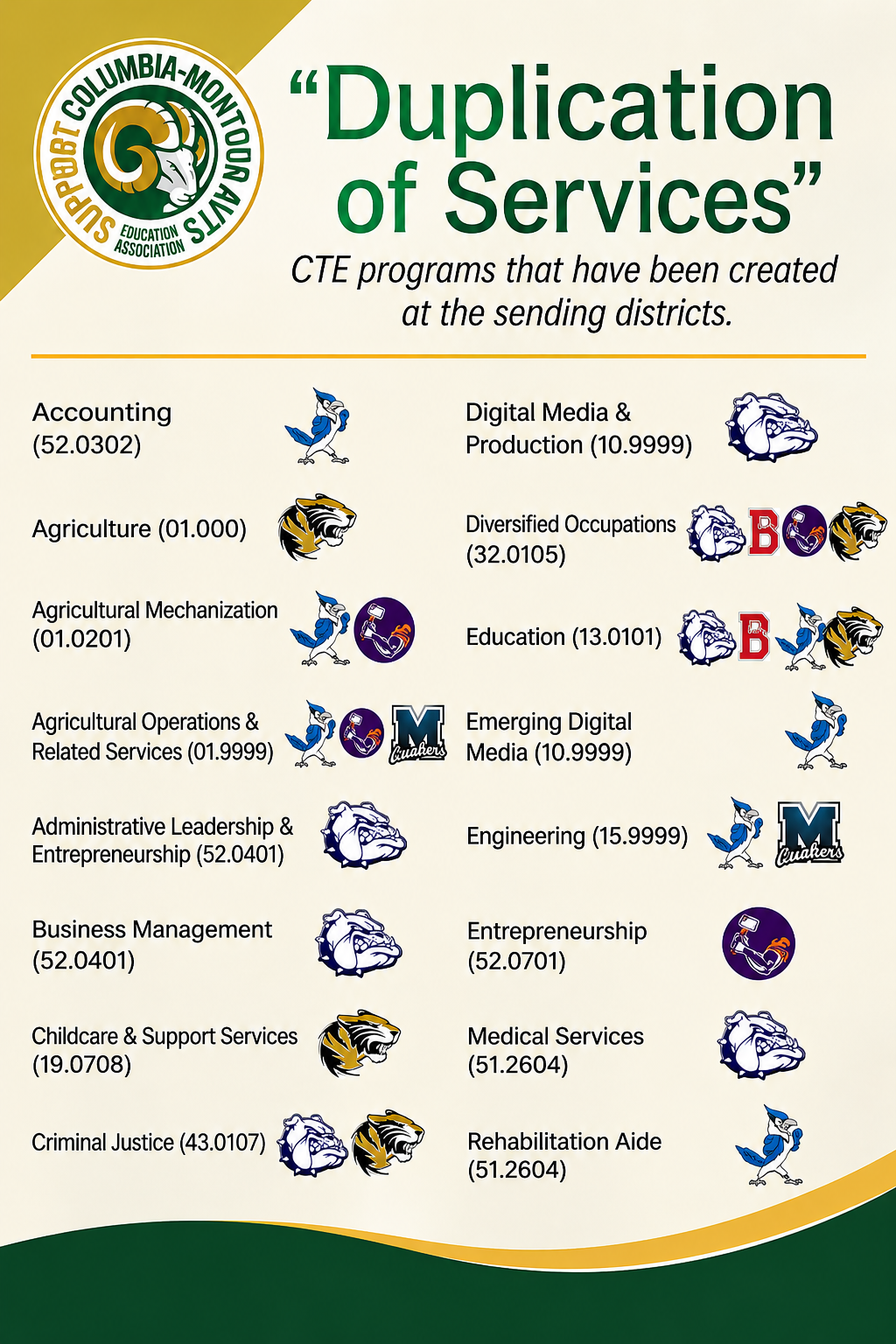
Several sending school districts offer career and technical courses or programs covering skills also taught at CMAVTS, including engineering, CAD, automation, media, and agriculture.
Pennsylvania allows approved CTE programs at both regional technical schools and individual school districts. However, overlapping offerings raise important questions about how public resources are coordinated.
Are we making the best use of taxpayer dollars by maintaining similar educational opportunities across multiple schools?
The available research identifies overlapping instruction but has not established how much, if any, unnecessary spending or enrollment loss results.
We believe the six sending districts should work together to evaluate these offerings, coordinate resources, and ensure that CMAVTS remains a strong, comprehensive career and technical school.
Our goal should be better regional coordination, responsible spending, and the strongest possible opportunities for students.
Understanding CMAVTS Funding: Is the Current Formula Fair?
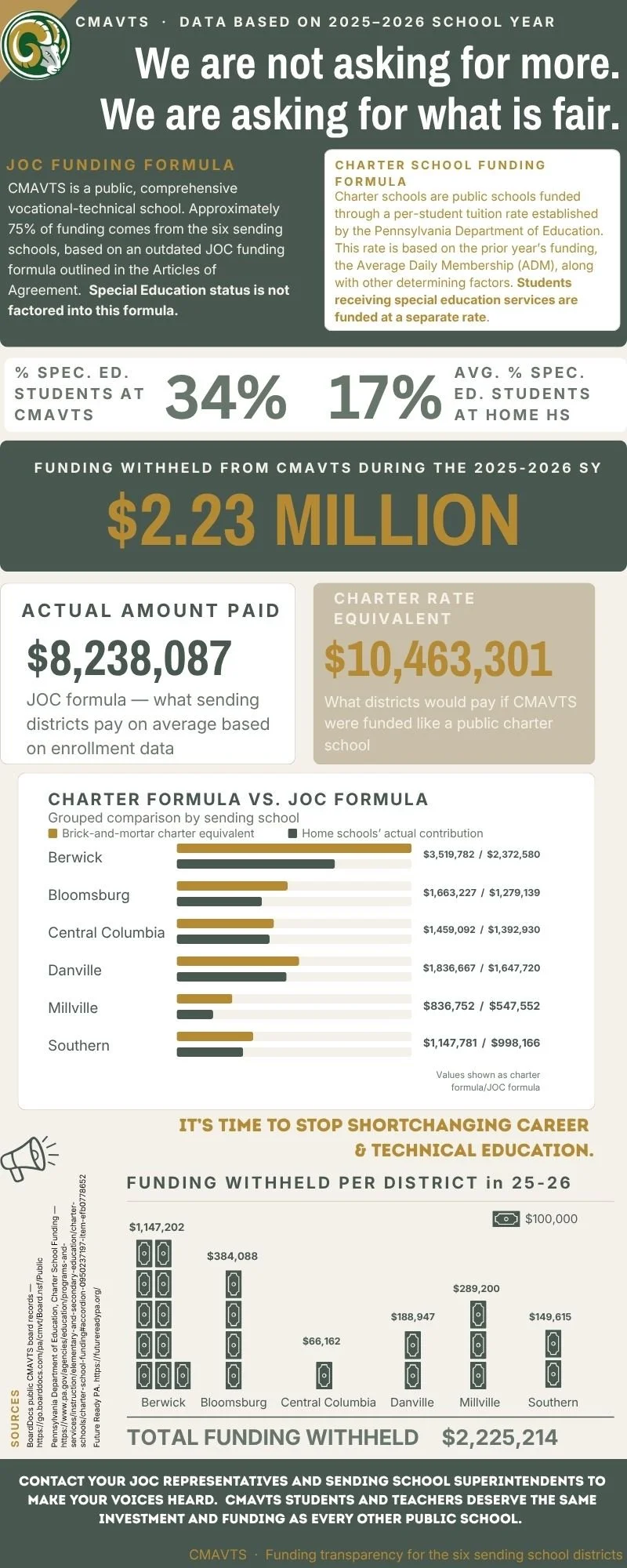
CMAVTS is funded through a formula established by its six sending districts. Unlike charter-school funding, this formula does not separately account for students receiving special education services.
For the 2025–26 school year, the infographic compares:
$8.24 million in actual district contributions under the JOC formula.
$10.46 million in estimated funding using a charter-school-equivalent calculation.
$2.23 million in additional funding under that hypothetical comparison.
The question is simple: Does the current funding formula adequately reflect the needs of CMAVTS students and programs?
Fair funding deserves an open discussion among all six sending districts.

Enrollment Trends: Why Now?
Since the 2004–05 school year, all six sending districts have experienced declining enrollment, while CMAVTS enrollment has remained comparatively stable.
According to the data presented, CMAVTS enrollment declined approximately 9%, compared with decreases of 19% to 31% across the sending districts.
This raises an important question: As sending districts face declining enrollment, how can we ensure CMAVTS continues to receive the support and investment it needs?
CMAVTS has demonstrated long-term enrollment stability. Its future deserves the same commitment.

Now Is the Time to Invest in Our Teachers
The CMAVTS Education Association reports $355,400 in personnel savings since the base year of the current contract, resulting from staffing changes and unfilled positions.
The Association believes these savings present an opportunity to invest in a fair, competitive teacher compensation through the proposed Weighted Average Metric (WAM).
Investing in our educators means investing in the quality and future of career and technical education at CMAVTS.
Fair compensation. Strong programs. A better future for our students.
What Is the Weighted Average Metric (WAM)?
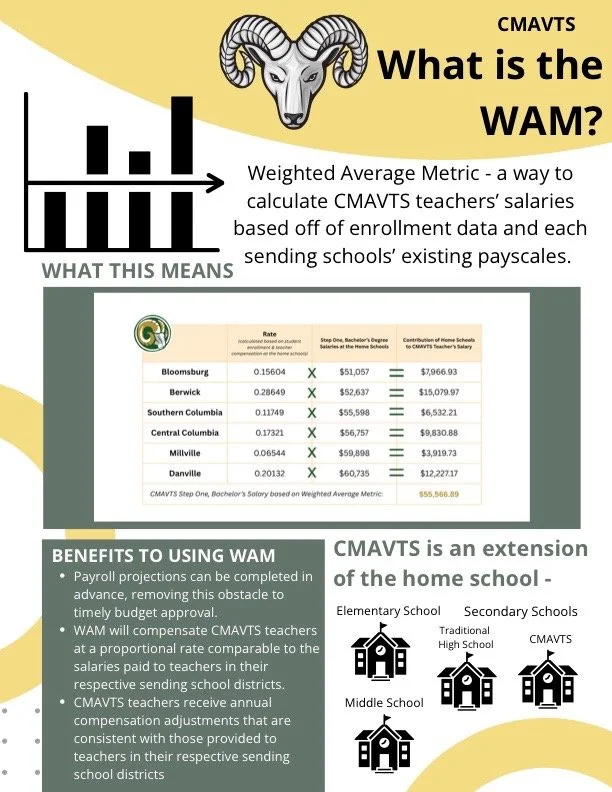
The Weighted Average Metric (WAM) is a proposed salary calculation method designed to align CMAVTS teacher compensation with the salary structures of the six sending school districts.
Rather than relying on a traditional, independently negotiated salary schedule, WAM uses each sending district's existing teacher salary schedule and a weighted calculation based on student enrollment to establish a compensation benchmark for CMAVTS educators.
Why does this matter?
CMAVTS serves students from all six districts, yet its educators operate under a separate compensation system. WAM offers a potential way to create a more consistent and transparent relationship between teacher salaries at CMAVTS and those at the sending schools.
The proposed approach offers several potential benefits:
Fairness: Connects CMAVTS compensation to the salary schedules of the districts it serves.
Consistency: Provides a framework for salary adjustments that reflect changes in sending district compensation.
Predictability: Could make future payroll projections and budgeting more straightforward.
Regional alignment: Recognizes CMAVTS as an extension of the educational opportunities provided by the six sending districts.
The goal is simple: Establish a fair, sustainable, and transparent compensation system that recognizes CMAVTS educators as an essential part of our regional public education system.
Proposed Salary Structure Could Cost Teachers Hundreds of Thousands Over Their Careers
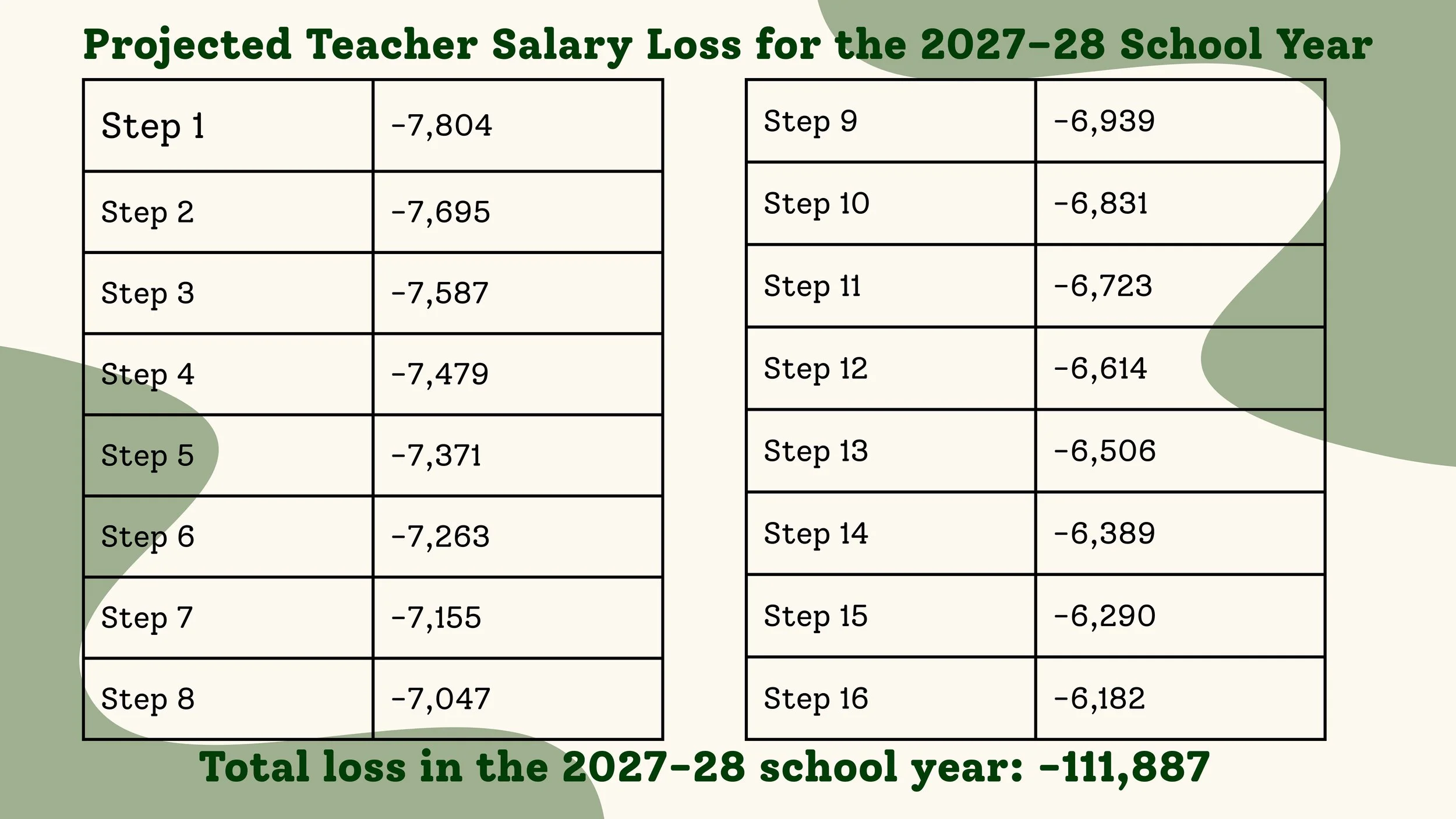
A controversial new compensation proposal from the Joint Operating Committee (JOC) could severely reduce earnings for local educators in the coming years. According to a detailed financial analysis of the 2027–28 school year, a teacher holding a Master’s degree advancing from Step 1 through Step 16 would face substantial pay cuts compared to the weighted average metric (WAM) of nearby sending schools. Initial annual losses are projected at $7,804 for first-year teachers at Step 1, with even veteran educators at Step 16 taking a $6,182 annual hit.
The long-term financial consequences are even more striking. Over their first 16 years of service, an educator’s cumulative lost wages would total $111,887. For teachers remaining at the top step for the remainder of a standard career, continued annual losses of $6,182 would add $117,458—bringing the total lifetime financial loss to a staggering $229,345 per employee.
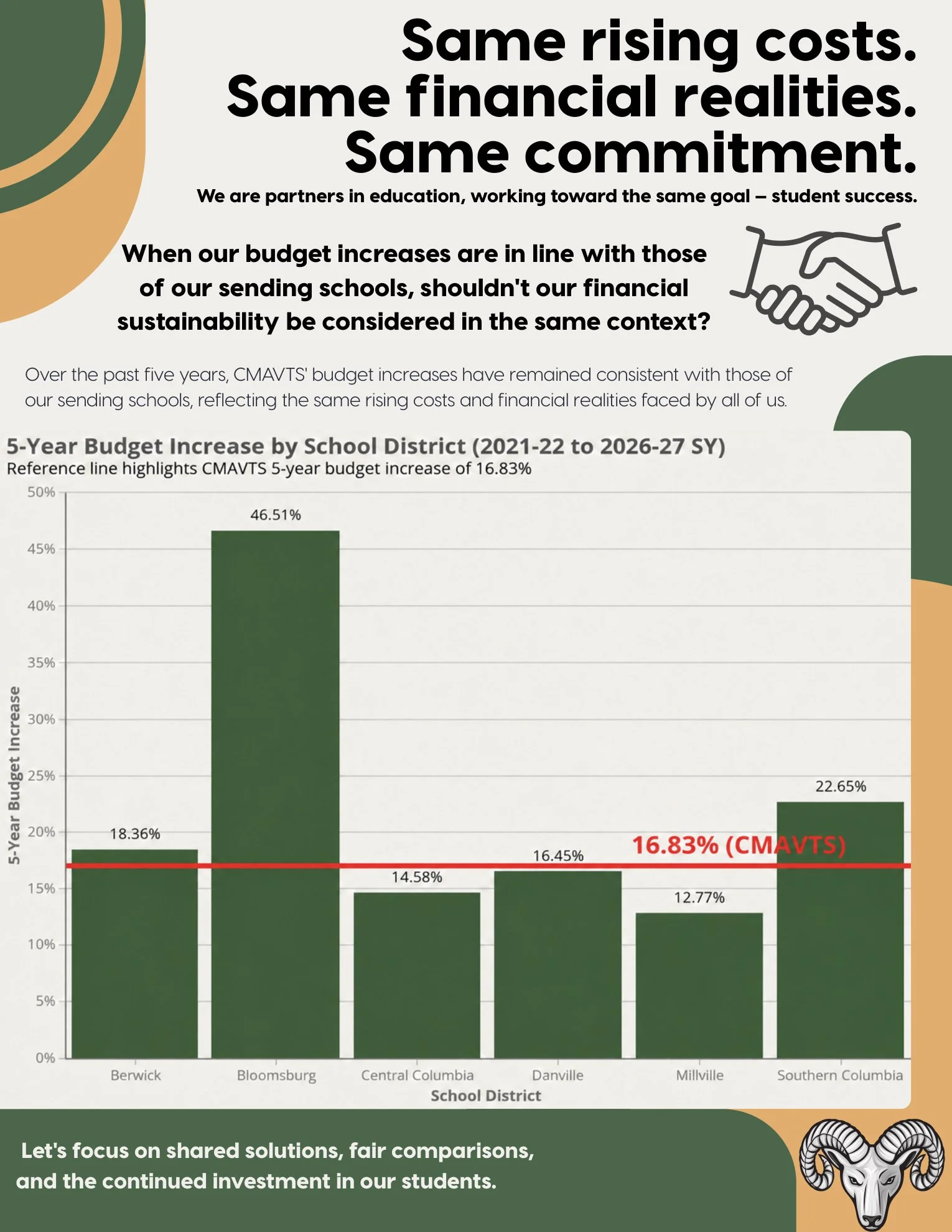
Same Rising Costs. Same Financial Realities. Same Commitment.
CMAVTS and its six sending school districts face many of the same financial challenges, including rising operational costs and the need to maintain quality educational programs.
From the 2021–22 through 2026–27 school years, CMAVTS experienced a cumulative budget increase of 16.83%, compared with increases ranging from 12.77% to 46.51% among its sending districts.
These figures raise an important question: If CMAVTS is managing budget increases comparable to those of its sending districts, shouldn't its long-term financial sustainability receive the same consideration?
CMAVTS is an essential part of our regional education system. Supporting its financial stability means protecting hands-on learning opportunities, maintaining strong career and technical programs, and preparing students for the workforce.
Different schools. Shared challenges. One commitment to student success.